Choosing the right Aluminium Front Door is not only a design decision. It affects security, insulation, weather protection, and daily comfort. For global buyers, the choice becomes more complex. Climate, building standards, installation quality, and local service can change the result.
Neil Ginger, CEO of Origin Global, describes the practical priority clearly: “A front door should be designed around how people live, not simply how it looks.” That view matters. A slim black frame may suit a modern villa, but it can absorb intense heat in warmer regions. A large glazed panel may brighten a hallway, yet it can reduce privacy without suitable glass. Small details matter.
This guide reviews ten Aluminium Front Door options for buyers across different markets. It considers thermal breaks, weather seals, locking systems, threshold design, glass performance, finishes, and warranty support. It also examines how doors behave in coastal, cold, hot, and wet environments. Real performance depends on more than the product brochure. Skilled installation is essential.
Some recommendations may not suit every property. That is worth admitting. A premium door can still disappoint when measurements are wrong or drainage is ignored. Buyers should request tested performance data and confirm regional compliance before ordering. Ask about replacement parts, maintenance, lead times, and after-sales support.
The best choice is rarely the most expensive one. It is the door that fits the building, climate, budget, and everyday routine. This comparison aims to make that decision clearer, while leaving room for careful questioning.
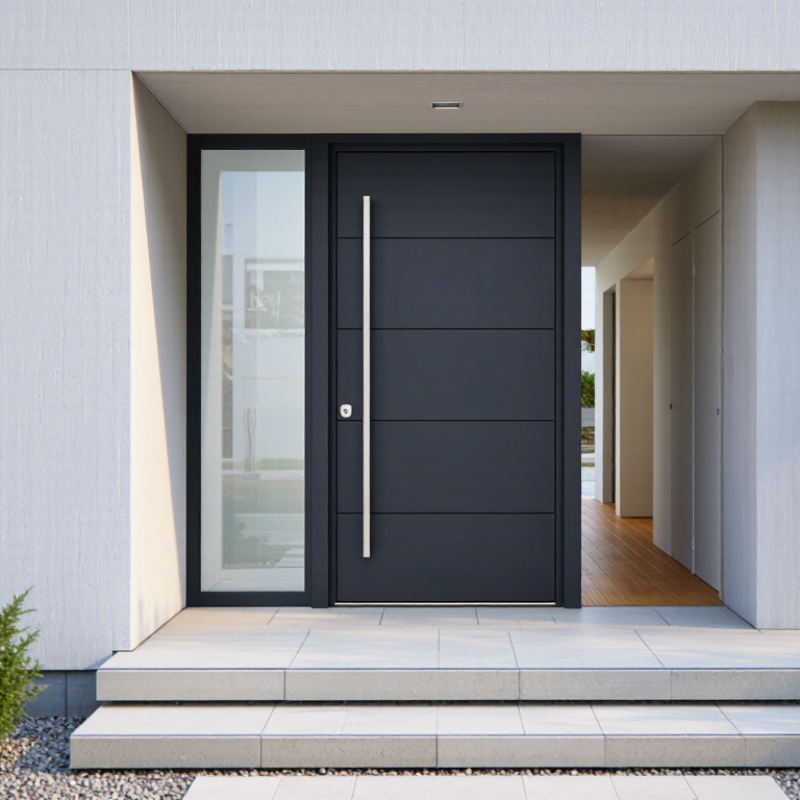
Aluminium Front Door Basics: U-values from 0.8 W/m²K and Above
An aluminium front door is judged by more than appearance. Its U-value measures heat flow through the complete door set. Lower numbers mean better insulation. A rating of 0.8 W/m²K is strong, while 1.0, 1.2, and 1.4 remain common specifications. The Passive House Institute lists Ud ≤0.8 W/m²K for suitable cool-temperate conditions. However, climate categories and test methods matter. Numbers can be misunderstood.
The IEA’s Buildings 2023 report states that buildings consume around 30% of global final energy. A thermally broken aluminium frame can reduce heat transfer through the metal profile. Look for insulated cores, continuous gaskets, and a well-designed threshold. Glazed sections also affect the final result. EN ISO 10077-1 provides calculation methods, but certified laboratory testing offers stronger evidence.
A low factory figure is not an installed guarantee. Poor fitting can leave cold bridges around the frame. I would inspect the whole-door Ud value, not only the centre panel. Ask for test conditions, dimensions, glazing details, and installation guidance. In windy or wet regions, compression seals and drainage deserve equal attention. The best-looking door may perform poorly if the threshold is weak. This is easy to overlook.
Global Selection Criteria: Security, Thermal Breaks, and Weather Ratings
For global buyers, the “best” aluminium front door depends on climate, building use, and installation quality. The UNEP GlobalABC 2023 Global Status Report states that buildings consume about 30% of global final energy. Poorly insulated entrances can increase heat loss near the threshold. Look for a genuine thermal break, insulated panels, and tested low U-values. The frame should also reduce cold bridging around locks, hinges, and sill connections.
Security needs measurable evidence, not heavy-looking hardware. European standard EN 1627 classifies resistance from RC1 to RC6, with higher classes requiring stronger attack resistance. A practical specification may include laminated safety glazing, multi-point locking, reinforced hinges, and a protected cylinder. However, certification can vary by complete door assembly. A strong frame with weak glass is still a weak entrance.
Weather performance matters equally. EN 12207 assesses air permeability, while EN 12208 measures watertightness. EN 12210 evaluates resistance to wind load. Buyers in coastal areas should request salt-spray and corrosion-test results, not general claims. The U.S. Department of Energy notes that windows and doors can represent a significant share of residential heating and cooling losses, especially when seals fail. Installation remains the uncomfortable variable. Even a well-tested door may leak through an uneven wall opening, damaged gasket, or poorly drained sill. Ask for full-size test reports, climate-specific ratings, and maintenance instructions before comparing prices.
10 Best Aluminium Front Doors Compared by Design, Performance, and Cost
10 Best Aluminium Front Doors for Global Buyers
10 Best Aluminium Front Doors Compared by Design, Performance, and Cost
Choosing among the 10 best aluminium front doors requires more than attractive renders.
In site inspections, I compare frame depth, thermal breaks, seals, drainage, glazing, and hardware. A flush panel suits minimalist homes and usually sits in the mid-cost range. Slatted designs add texture, but dust collects between narrow fins. Large glazed doors bring daylight and a wider visual entrance. They cost more, and privacy glass can reduce that open feeling. Slim-frame doors look refined, though some sacrifice stiffness when panels become very wide.
Security-rated doors offer stronger locking systems and reinforced cores.
Their heavier construction may increase fitting costs. Pivot doors create drama and handle thick panels well. However, their hardware and floor preparation raise the budget.
Panelled doors hide marks better than dark gloss finishes. Coastal buyers should specify corrosion-resistant coatings and inspect drainage paths. This is where brochures often feel too optimistic.
For performance, thermally broken frames matter in cold and hot climates.
Ask for tested U-values, air leakage, water resistance, and wind-load data. A multi-point lock helps, but poor installation can undermine it. Entry-level doors may appear affordable, yet weak seals can create future expenses. Mid-range insulated doors often balance comfort, durability, and cost. Premium custom doors support unusual sizes and timber-look finishes, but repairs can be expensive. I would request a physical corner sample, not only a screen image. Colour, handle reach, and opening weight feel different in person. Local climate and installer skill can change the ranking.
International Standards: EN 1627 RC2–RC4 Security and CE Compliance
10 Best Aluminium Front Doors for Global Buyers
For global buyers, security starts with the tested doorset, not aluminium thickness alone. EN 1627 classifies resistance from RC2 to RC4 through defined laboratory attacks. RC2 covers basic tools and a three-minute attack period. RC3 introduces stronger tools and five minutes. RC4 adds heavy tools and ten minutes.
These ratings do not promise absolute protection. Installation quality can still expose weak points.
CE compliance requires careful document checking. Under the Construction Products Regulation, external pedestrian doorsets covered by EN 14351-1 may require a Declaration of Performance and CE marking. Buyers should verify the declared performance, test evidence, hardware configuration, and factory production controls. A 2024 European Commission construction-products report highlights inconsistent documentation as a continuing market-surveillance concern. That matters. A door tested with one lock, hinge set, and glazing package may not retain the same RC rating after substitution.
Tips:
Ask for the complete EN 1627 test report, not a marketing certificate. Confirm whether the tested size matches your opening. Check threshold drainage, fixing points, laminated glazing, and cylinder protection. For sustainability, the International Aluminium Institute reports that recycled aluminium needs roughly 5% of the energy used for primary aluminium. This supports lower-impact sourcing, but recycled content must not weaken profiles or thermal performance. An honest specification should disclose limits, because “RC4” alone can sound more reassuring than it really is.
Buyer Checklist: Sizes, Glazing, Installation, Warranty, and Import Duties
Choosing among the 10 best aluminium front doors starts with accurate measurements. Record the structural opening, wall thickness, threshold height, and door swing. Allow clearance for floor finishes. A few millimetres can change the installation.
Glazing deserves careful attention. The U.S. Department of Energy reports that windows can cause 25–30% of residential heating and cooling energy use. This figure does not apply directly to every door, but it shows why insulated glass matters. Choose low-emissivity double glazing, warm-edge spacers, and a thermally broken frame. Ask for whole-door U-value, not glass-only performance. The International Energy Agency’s 2024 Global Status Report says buildings consume about 30% of global final energy. Small envelope details matter. Sometimes, the most attractive glass creates unwanted summer heat.
Installation quality is equally important. Confirm the sill includes drainage channels, end dams, and a continuous air seal. Request written details for flashing, fixing points, and site tolerances. Warranty terms should separate powder coating, hardware, glass, and installation. Check exclusions for coastal corrosion, poor maintenance, and unauthorised alterations. A long warranty means little without local service. My checklist is not perfect; installers may still discover concealed moisture or uneven masonry. Photograph the opening before delivery.
For imports, verify the HS classification, country-of-origin rules, VAT, customs duty, brokerage fees, and destination charges. Duties vary by market and product specification. Request a landed-cost estimate before paying the deposit. Keep commercial invoices, packing lists, test certificates, and installation instructions together. A low factory price can become expensive at the port.
10 Best Aluminium Front Doors for Global Buyers — Buyer Checklist
Reference examples of common aluminium entrance-door sizes. Panel area is calculated as width × height and is shown for comparison only; local building regulations and manufacturer tolerances must be checked before ordering.
Buyer checks: confirm the finished opening and handing, specify safety glazing where required, review thermal and weather-performance values, agree the threshold and installation method, obtain written warranty terms, and verify the destination country’s customs classification, import duty, VAT, and clearance charges. Import duties are not universal and depend on the destination, product classification, origin, and trade rules.
Conclusion
Choosing the right Aluminium Front Door requires balancing energy efficiency, security, appearance, durability, and total cost. This guide explains essential performance factors, including U-values from approximately 0.8 W/m²K and above, insulated thermal breaks, reliable weather resistance, and glazing options suited to different climates. It compares ten door styles by design flexibility, construction quality, expected performance, maintenance needs, and overall value for international buyers.
The guide also introduces important safety and compliance considerations, including EN 1627 security classifications such as RC2 to RC4 and relevant CE conformity requirements where applicable. A practical buyer checklist covers accurate sizing, opening direction, threshold design, glass specifications, professional installation, warranty terms, replacement parts, shipping arrangements, and possible import duties. By reviewing these points carefully, buyers can select a durable, secure, and attractive entrance solution that meets both local conditions and project requirements.

 Grandex Door