Choosing an Aluminum Exterior Door manufacturer in China is not just a price comparison. A door may look polished in a catalog, yet its frame, finish, hardware, and weather seals shape its performance through years of rain and daily use. Small details matter. This guide introduces manufacturers and explains what buyers can check before requesting a quote. It focuses on practical evidence: product range, documented specifications, customization options, quality-control processes, and communication during sampling. Claims deserve questions. Ask how dimensions are measured, which coating systems are available, and whether test reports apply to the exact model under consideration.
China has a broad supplier landscape, from large exporters with established project teams to smaller factories serving custom orders. Their strengths are not identical, and a familiar name alone cannot confirm a suitable fit. That is the point. The shortlist should be treated as a starting place, not an endorsement or guarantee. Compare the same opening size, glass configuration, finish, hardware, packaging, and delivery terms across quotations. Request recent project references and clear drawings; verify certifications with the issuing body when relevant. Even careful checks have limits. Samples can differ from production, and shipping conditions may affect the final product. The best choice is usually the manufacturer that answers specific questions clearly, documents its promises, and can show how the door is made—not simply the one with the lowest price. Use the sections ahead to narrow the field with a practical, informed view.
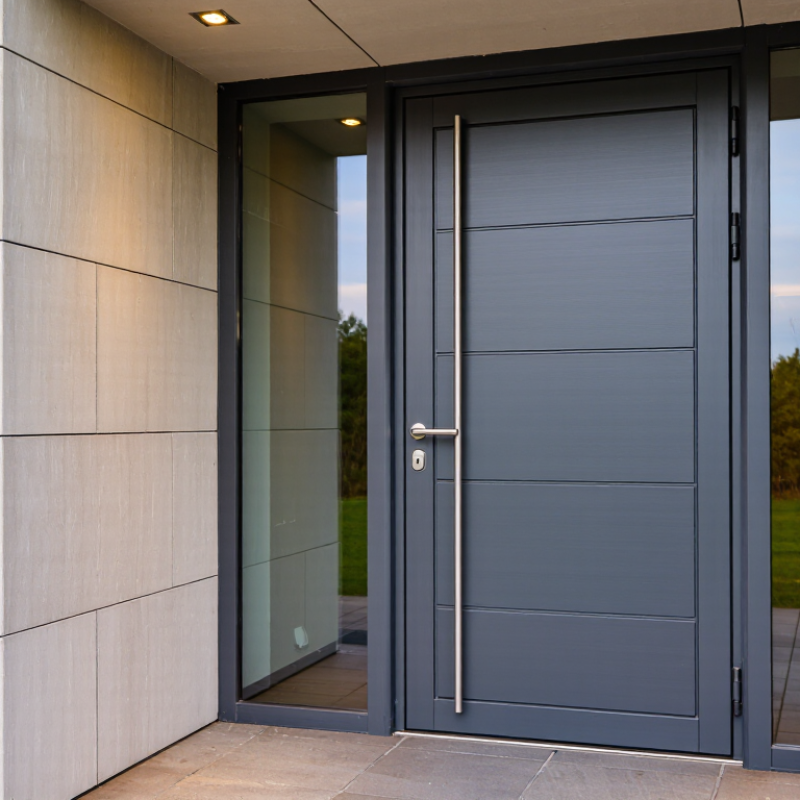
An aluminum exterior door is a complete weather-facing assembly, not just a metal slab. It includes the frame, door leaf, threshold, seals, hardware, and any glazing. Aluminum is valued for its strength and resistance to corrosion, allowing slim frames and broad glass panels. Yet metal conducts heat readily. A thermal break—a low-conductivity insert separating the inner and outer frame—helps limit heat transfer. Details matter.
Performance depends on more than the frame material. Tight perimeter gaskets, a well-fitted threshold, and secure locking points help reduce drafts and water entry. If the door includes glass, check its U-factor and solar heat gain coefficient, not just its appearance. The U.S. Department of Energy reports that windows account for about 25–30% of residential heating and cooling energy use. That figure applies to windows, not doors, but it highlights why glazing and air leakage deserve attention in glazed entrance systems.
The UNEP 2023 Global Status Report for Buildings and Construction estimates that buildings use about 34% of global energy. A door alone cannot solve that challenge, but its fit and insulation affect the building envelope. Ask for tested air, water, and structural performance, plus the test standard and product configuration. A polished specification sheet is useful, not conclusive; installation quality can still make the real-world result disappointing.
This comparison shows approximate material-property indices for pure aluminum relative to representative carbon steel, with steel set to 100. Aluminum’s low density helps keep doors lightweight, while its high thermal conductivity means thermal breaks and insulated glazing are important design considerations. Actual door performance depends on the alloy, frame design, glazing, seals, and installation.
Approximate reference values: aluminum—2.70 g/cm³ density, 69 GPa elastic modulus, 660°C melting point, and 237 W/m·K thermal conductivity; carbon steel—7.85 g/cm³, 200 GPa, 1,450°C, and 54 W/m·K, respectively. Values vary by alloy and reference.
Aluminum exterior doors combine slim sightlines with a strong frame, allowing larger glass panels without bulky profiles. Their rigid construction can help doors stay aligned through frequent use. Thermal-break frames reduce heat transfer, while insulated glazing can improve indoor comfort. Performance depends on the full assembly, not the frame alone. A narrow frame is not automatically an efficient one.
Weather seals, drainage channels, and durable surface finishes help manage rain, wind, and daily wear. Check how the corners are joined and whether the threshold directs water away from the interior. In coastal areas, suitable protective finishes and regular rinsing can limit salt-related surface damage. Maintenance still matters. It is easy to overlook the seals until a draft appears.
These doors suit house entrances, patio openings, garden rooms, and some commercial buildings. A glazed entrance can bring daylight into a hallway, while a wide patio door connects indoor living areas with a deck. For busy entrances, confirm that hinges, locks, and handles are rated for the door’s weight and use. Specifications can look impressive on paper; careful installation often makes the difference.
Assessing Chinese door manufacturers takes more than comparing prices and catalog photos. Ask for a section drawing that shows the aluminum profile, thermal break, glazing, seals, and drainage path. A capable supplier should explain how these parts work together, not just quote a frame thickness. Details matter.
Request recent project references and check whether the door dimensions, finish, and hardware match your requirements. For a sample, inspect corner joints, coating consistency, gasket contact, and how smoothly the lock operates. Ask what tests are performed for air and water resistance, and request dated reports that identify the tested door configuration. One report may not cover every size or design. I would not judge a factory by one polished sample alone.
Communication is part of the assessment. Send a clear specification and note how the manufacturer handles questions, revisions, and lead-time changes. Confirm packaging details, replacement-part availability, and who checks quality before shipment. If possible, arrange a live video walkthrough of production and inspection records. A tidy showroom proves little. Factory checks can also miss issues, especially when schedules are tight. Be candid about uncertainty, and compare evidence from several sources before making a decision.
| Assessment Area | What to Check | Evidence to Request | How to Assess |
|---|---|---|---|
| Product and project fit | Confirm the supplier makes exterior aluminum doors suited to the intended opening, climate, installation method, and use. | Product drawings, configuration options, project references, and a written specification for the proposed door set. | Compare the documented configuration with your opening dimensions, exposure conditions, and project requirements. |
| Applicable standards | Check which standards apply in the destination market and whether the offered product has been tested to relevant requirements. | Test reports that identify the product configuration, test method, laboratory, report date, and results. For China, GB/T 8478-2020 covers aluminum alloy doors and windows; GB/T 7106-2019 covers test methods for air permeability, water tightness, and wind-load resistance of building doors and windows. | Verify that the report covers the same frame, leaf, glazing, hardware, and size range as the product being quoted. A standard reference alone is not proof of compliance. |
| Air, water, and wind performance | Assess performance against the exposure and building-code requirements for the project location. | Current laboratory reports showing test results and the tested specimen’s construction and dimensions. | Compare measured results with the project specification. Do not assume that a result for one configuration applies to every door size or design. |
| Thermal performance | Check the thermal-performance requirement for the climate zone and applicable local regulations. | Test or calculation documentation stating the method, declared value, frame and glazing details, and configuration assessed. GB/T 8484-2020 addresses thermal insulation performance testing for building doors and windows in China. | Compare like-for-like values and confirm whether the figure applies to the complete door set or only a component. |
| Aluminum profiles and finish | Review profile dimensions, alloy and temper documentation, section design, coating type, and finish options. | Profile drawings, material documentation, coating specifications, and inspection records for appearance and coating thickness where specified. | Match the proposed materials and finish to the order specification; agree on approved samples and acceptance criteria before production. |
| Glazing and hardware | Confirm glass build-up, safety-glazing requirements, seals, locks, hinges, and other specified hardware. | Component schedules, glass specifications, hardware data sheets, and details of compatibility with the tested door configuration. | Check that components meet the project requirements and are identified consistently in drawings, quotation, samples, and test documents. |
| Quality management | Evaluate documented controls for incoming materials, production, inspection, nonconforming products, and corrective action. | Quality procedures, inspection records, traceability examples, and any current management-system certificate with its scope and issuing body. | Treat a management-system certificate as evidence of a certified system, not as proof that a particular door meets performance requirements. |
| Manufacturing capability | Check whether the factory can produce the required sizes, opening styles, finishes, and order volume consistently. | Production process overview, equipment list relevant to the order, capacity information, sample approval process, and factory audit access where available. | Confirm capability against the actual project scope and schedule rather than relying on general capacity statements. |
| Export and destination-market compliance | Identify applicable product, labeling, documentation, and import requirements in the destination country. | Market-specific compliance documents and a written list of included technical files, labels, packaging details, and shipping documents. | Verify requirements with the relevant authority or qualified local adviser. For the EU, assess the applicable requirements for external pedestrian doorsets, including EN 14351-1 where relevant. |
| Quotation and contract clarity | Check scope, dimensions, tolerances, finish, glass, hardware, packaging, delivery terms, lead time, and exclusions. | Itemized quotation, approved shop drawings, order specification, payment schedule, and written change-control terms. | Resolve differences between the quotation and technical documents before placing the order; avoid relying on verbal confirmations. |
| Warranty and after-sales support | Clarify warranty coverage, exclusions, claim process, spare-parts availability, and responsibility for installation-related issues. | Written warranty terms, service contact details, claims procedure, and stated availability of replacement components. | Check that coverage, duration, and remedies are explicit and workable in the destination market. |
Evaluation tip: Compare manufacturers using the same door specification and require product-specific evidence. Standards, test results, certificates, and warranty terms should be independently checked for scope, validity, and relevance to the destination market.
Leading aluminum exterior door manufacturers in China typically serve residential, commercial, and export projects. Their capabilities vary: some focus on standard hinged doors, while others can customize sliding systems, frame sizes, finishes, and hardware. A dependable supplier should explain the aluminum profile thickness, thermal-break design, glass options, and stated air- and water-resistance performance. Ask for evidence. Clear answers matter more than polished product photos.
When comparing factories, review drawings, finish samples, and assembly details before approving a production run. Check how door corners are joined, how seals meet at the threshold, and whether drainage openings are properly positioned. For coastal projects, ask about coating specifications and corrosion testing. Details matter. A specification sheet is useful, but it cannot show every variation in actual workmanship.
Request recent project references and confirm which operations happen in-house, such as cutting, powder coating, and final assembly. A pre-shipment inspection can help catch scratches, uneven gaps, or hardware that feels stiff. I would not assume that a large catalog means consistent quality; that assumption can be wrong. Compare the approved sample with finished units, and document acceptable tolerances before ordering.
When comparing aluminum exterior door manufacturers in China, ask for test reports tied to the exact door configuration—not just a catalogue sample. Check frame depth, alloy and finish specifications, then review air leakage, water penetration, wind-load, and thermal results. China’s GB/T 8478-2020 standard covers aluminum alloy doors and windows, but a standards reference alone does not prove every model was tested. Ask an accredited laboratory to verify the report and its scope.
Certifications need careful reading. ISO 9001 indicates a quality-management system; it does not certify a door’s weather resistance or insulation. The IEA’s Buildings report (2023) estimates that buildings use about 30% of global final energy and produce 26% of energy-related emissions. That makes documented thermal performance relevant, especially for exposed entrances. Small details matter: inspect corner joints, drainage paths, gasket continuity, and whether hardware withstands repeated use. A polished showroom still proves little.
Service quality is easier to assess through specific commitments. Request shop drawings, written lead times, packing details, installation guidance, and spare-parts support. Ask how damage claims are documented and resolved. Compare warranty exclusions, not just warranty length. A response may sound reassuring, yet remain vague; request a sample inspection checklist or a real test report. I would not rank suppliers by price alone. Still, paperwork cannot replace checking one finished door under realistic site conditions.
It includes a frame, door leaf, threshold, seals, hardware, and sometimes glazing. Each part affects weather protection. Details matter.
Aluminum transfers heat readily. A low-conductivity insert between the inner and outer frame can reduce heat transfer.
Review the glass U-factor and solar heat gain coefficient. Also inspect the seals around each glass panel for gaps.
Ask for air-leakage, water-penetration, wind-load, and thermal results. Reports should identify the tested door’s size and configuration.
No. It indicates a quality-management system, not weather resistance or insulation. Check product-specific test evidence.
Look at corner joints, coating consistency, gasket contact, drainage paths, and lock operation. A sample can still hide problems.
Request shop drawings, written lead times, packing details, installation guidance, and spare-parts information. Ask how damage claims are handled.
No. Compare dated reports, project references, and sample inspections. I might still miss something, so check the evidence carefully.
An Aluminum Exterior Door is designed to provide a durable, weather-resistant entrance for homes and commercial buildings. Commonly made with strong, lightweight frames and insulated glass or panel options, it can offer reliable security, thermal performance, and a clean modern appearance. These doors suit main entrances, patios, balconies, and other exterior openings where durability and ease of maintenance matter.
When evaluating Chinese manufacturers, buyers should consider production experience, material and hardware quality, customization options, quality-control procedures, and communication throughout the order process. Rather than choosing by price alone, compare product specifications, relevant certifications, warranty terms, delivery capabilities, and after-sales support. Leading manufacturers can be assessed by how consistently they meet these requirements and how well their products fit the project’s climate, design, and performance needs. A careful comparison helps identify a supplier that offers dependable quality and service for the intended application.

Grandex Door