Choosing among China’s top aluminium entry door manufacturers requires more than comparing catalogue photos. A reliable evaluation examines material quality, engineering depth, production consistency, and after-sales support. This guide explores suppliers producing the Aluminium Entry Door for villas, apartments, hotels, offices, and commercial developments. It considers aluminium alloy grades, profile thickness, thermal-break systems, glass specifications, hinges, locks, seals, and surface finishes. Small details matter. A door may look impressive, yet poor drainage can cause problems after heavy rain.
Factory experience also deserves close attention. Established manufacturers often provide project drawings, sample testing, installation guidance, and export packaging suited to long-distance shipping. Their workshops may include CNC machining, powder-coating lines, assembly areas, and inspection stations. However, equipment alone does not prove reliability. Buyers should request test reports, production photographs, reference projects, and clear warranty terms. Independent verification remains valuable.
The word “top” is not absolute. A large manufacturer may offer strong capacity but limited design flexibility. A smaller specialist may deliver better customization, but with slower production. That trade-off deserves honest consideration. Some supplier claims can sound polished. They still need evidence. This overview therefore focuses on practical performance, communication quality, customization control, and documented manufacturing standards. It aims to help architects, developers, contractors, and homeowners make a more informed decision. No factory is perfect. Careful questions often reveal the difference.
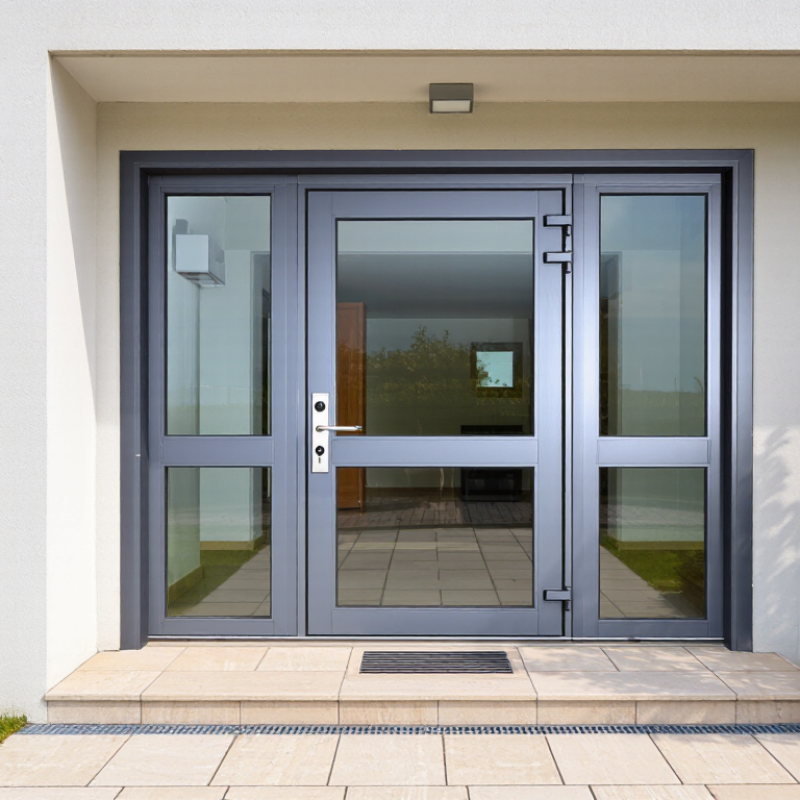
China’s top aluminium entry door manufacturers are defined by more than factory size or attractive catalogues. They combine proven engineering, consistent production, and responsive technical support. Experienced manufacturers understand how aluminium profiles, thermal breaks, seals, hinges, and locks work together. A well-built door should close smoothly, resist wind-driven rain, and remain stable after repeated daily use.
Reliable suppliers can explain alloy grades, powder-coating standards, glass specifications, and hardware options in clear language. They provide drawings, production samples, inspection records, and traceable quality checks. Site conditions also matter. A manufacturer should ask about opening sizes, wall structure, local weather, drainage, and installation skills before confirming details. This practical questioning shows expertise. However, even capable factories can make mistakes when measurements are rushed or specifications change late.
Tips: Request a sample corner, not only product photos. Check welds, profile joints, gasket compression, and coating consistency under natural light. Ask for test data and installation guidance. Confirm how defects, replacement parts, and delivery damage are handled. A factory may promise customization, yet the real test is whether its drawings match the finished door. Pay attention to that gap.
China’s aluminium door sector benefits from strong raw-material capacity. The National Bureau of Statistics recorded 41.59 million tonnes of primary aluminium output in 2023. However, that figure does not prove finished-door compliance. The International Aluminium Institute projects global aluminium demand could rise nearly 80% by 2050. Quality control will matter more. Not enough.
GB/T 8478-2020 does not simply approve one alloy grade. It requires aluminium doors and windows to meet applicable material, profile, performance, and inspection requirements. Common choices include 6063-T5 and 6063-T6 profiles. 6060 profiles may also work when their certified properties meet the project specification. The temper alone is insufficient. Profile dimensions, wall thickness, tolerances, surface treatment, sealing, hardware connection, air tightness, water tightness, and wind-pressure resistance require verification. These requirements should be read with GB/T 5237.1 and the relevant coating parts, including anodizing, electrophoretic, powder, or fluorocarbon finishes.
A reliable manufacturer should provide the alloy certificate, temper designation, batch number, and profile inspection record. Ask for test evidence under GB/T 8478-2020, not only a sales brochure. Check the batch. In practice, paperwork can be incomplete, even when the extrusion appears clean and straight. That is an uncomfortable weakness in supplier evaluation. Designers should also confirm thermal insulation and structural calculations for the actual opening size. A 6063-T5 profile may be suitable for one entrance, but inadequate for a taller, wider, or heavily exposed installation. Sources: National Bureau of Statistics of China, 2023 Industrial Production Data; International Aluminium Institute, Aluminium Sector Greenhouse Gas Pathways Report.
Technical comparison of commonly used aluminium alloys, profile configurations and compliance checks for aluminium entry doors. GB/T 8478-2020 is a product standard for aluminium alloy doors and windows; it does not automatically approve one specific alloy, profile series or manufacturer.
| Technical Dimension | Typical Aluminium Alloy or Profile | Verified Technical Characteristics | Suitability for Entry Doors | GB/T 8478-2020 Compliance Focus | Recommended Procurement Evidence |
|---|---|---|---|---|---|
| Primary architectural alloy | 6063 Al-Mg-Si alloy |
Widely used for architectural extrusions because it offers good extrusion performance, surface finishing quality and corrosion resistance when properly processed. | Suitable for door frames, stiles, rails, muntins and decorative architectural profiles. The final strength depends on the temper, section design and manufacturing process. | Verify that the completed door assembly satisfies the required structural, operational, sealing and durability performance. Alloy designation alone is not proof of compliance. | Mill certificate, alloy and temper designation, chemical-composition report, profile inspection report and completed-door test documentation. |
| Architectural extrusion option | 6060 Al-Mg-Si alloy |
Offers high extrudability and a good surface finish for architectural sections. It is commonly considered where complex or visually refined profile shapes are required. | Suitable for many frame and trim applications, subject to the required load, span, hardware and wall-thickness design. | Confirm that the selected temper and profile section provide the required resistance to wind pressure, repeated operation and connection forces. | Material certificate, temper record, extrusion dimensional report, corner-joint test results and assembly performance reports. |
| Higher-strength option | 6061 Al-Mg-Si-Cu alloy |
Generally provides higher strength than common architectural 6063 sections, but may have different extrusion and surface-finishing characteristics. | Useful for large, heavy or highly loaded door components when confirmed by structural calculation. It is not automatically the best choice for every architectural profile. | Check profile deformation, hardware fixing, welded or mechanically joined areas, corrosion protection and the performance of the complete door assembly. | Alloy and temper certificate, engineering calculation, profile-load verification and test report for the finished door set. |
| Strength-enhanced extrusion option | 6005A Al-Mg-Si-Mn alloy |
An aluminium alloy used where higher mechanical performance is needed in extruded sections. Its suitability depends on availability, temper control and profile geometry. | Can be considered for large-format frames, reinforced stiles or heavy-duty sections, provided that the design and finishing system are compatible. | Do not substitute it for a specified alloy without design approval. Verify dimensional stability, joining details and the required door performance. | Traceable batch certificate, heat-treatment record, section-property calculation and finished-product inspection records. |
| Common temper selection | T5 Artificially aged extrusion temper |
T5 identifies an aluminium temper produced by cooling from an elevated-temperature shaping process followed by artificial ageing. | Frequently used for architectural extruded profiles where the required strength and dimensional performance can be achieved by the selected section. | Confirm that the actual temper, profile wall thickness and section properties match the approved design and test specimen. | Temper designation on the certificate, heat-treatment records, hardness or mechanical-property verification and production traceability. |
| Higher-strength temper option | T6 Solution heat-treated and artificially aged temper |
T6 identifies a solution heat-treated and artificially aged condition. It may provide higher strength than a comparable T5 condition, depending on alloy and product form. | Consider for heavily loaded or large door sections after checking extrusion limitations, distortion risk, machining and joining requirements. | Confirm that higher material strength does not create weaknesses at corners, fasteners, hinges, locks or thermally separated joints. | Heat-treatment certificate, mechanical-property report, joint-strength verification and complete-door test records. |
| Non-thermal-break profile | Single aluminium hollow or semi-hollow profile | Aluminium provides good structural rigidity and weather resistance, but it also has high thermal conductivity. A single-metal profile creates a direct thermal bridge. | Suitable for moderate-climate, interior, utility or thermally uncritical applications when the project specification permits it. | Check air permeability, water tightness, wind pressure resistance, operating performance and the project’s thermal-performance requirement. | Profile drawings, wall-thickness inspection, gasket details, water-drainage details and complete-door laboratory or project test reports. |
| Thermally broken profile | Aluminium profiles joined with polyamide thermal barriers | A thermal barrier separates the interior and exterior aluminium portions, reducing direct heat flow through the frame. Performance depends on barrier geometry, profile design, seals and installation. | Preferred for conditioned buildings, energy-efficient projects and climates with significant indoor-outdoor temperature differences. | Verify the assembled door’s thermal, air, water and structural performance rather than evaluating the thermal strip alone. | Thermal-barrier material specification, assembly drawings, thermal calculation or test report, crimping inspection and finished-door test report. |
| Weather-resistant frame design | Multi-chamber frame with EPDM or equivalent sealing system | Multiple sealing lines, properly compressed gaskets and controlled drainage improve resistance to air infiltration and rain penetration. | Suitable for exterior entry doors when gasket compression, corner continuity and drainage paths are correctly designed. | Check air permeability, water tightness, drainage openings, gasket compatibility, corner vulcanisation or joining and threshold detailing. | Gasket material data sheet, seal-compression design, drainage drawing, water-tightness test report and installation instructions. |
| Heavy-duty entry-door profile | Reinforced stile, rail and hinge-side sections | Larger section depth, suitable wall thickness and local reinforcement can improve resistance to door leaf weight, wind load and hardware forces. | Recommended for tall, wide, glazed, security-focused or frequently used entry doors. | Confirm deflection, corner-joint strength, hinge and lock fixing, glass load transfer, operating cycles and wind-pressure performance. | Section drawings, engineering calculations, hardware-fixing details, cyclic-operation test records and structural test reports. |
| Threshold and drainage profile | Low-threshold or raised-threshold aluminium sill | Threshold geometry affects accessibility, water drainage, air sealing, weather performance and the transition between indoor and outdoor surfaces. | Select according to accessibility requirements, exposure level, drainage capacity and the required door opening direction. | Verify water tightness, drainage capacity, seal continuity, trip risk, compatibility with the floor finish and installation tolerances. | Threshold section drawing, drainage calculation or test evidence, seal layout, installation detail and site inspection checklist. |
| Surface treatment | Anodizing, powder coating or liquid coating | Surface treatment improves appearance and corrosion protection. Actual durability depends on pretreatment, coating thickness, curing, environment and maintenance. | Choose according to coastal exposure, industrial atmosphere, ultraviolet exposure, colour requirement and cleaning conditions. | Confirm appearance, adhesion, coating or anodic-film requirements, colour consistency, corrosion resistance and compatibility with seals and accessories. | Surface-treatment specification, colour sample approval, coating-thickness report, adhesion test and corrosion-resistance test where required. |
| Glazing and panel interface | Glass-retaining bead, gasket and setting-block system | The glazing system transfers glass loads, controls movement and contributes to air and water sealing. Glass type and thickness must match the approved design. | Suitable for glazed entry doors only when the glass, bead, gasket, setting blocks and frame are designed as one system. | Verify glass safety requirements, rebate dimensions, drainage, seal compression, edge clearance and resistance to wind and operational loads. | Glass specification, glazing schedule, gasket data, setting-block layout, fabrication instructions and finished-door inspection report. |
| Overall GB/T 8478-2020 assessment | Complete door assembly, not an aluminium alloy alone | Compliance is evaluated through the specified product requirements, manufacturing quality, inspection procedures and relevant performance testing of the finished aluminium door or window. | A door should be approved based on its complete configuration: profiles, alloy and temper, hardware, glass or panel, seals, joints, coating and installation. | Establish the applicable project classes and test requirements, then verify the production configuration against the tested configuration. | Product drawings, bill of materials, material certificates, factory inspection records, type-test report, sampling records and installation quality records. |
Technical note: GB/T 8478-2020 should be used together with the applicable material, coating, glass, hardware, sealing and building-performance standards. The alloy grades and profile types shown above are common technical options, not automatic proof that a door complies with GB/T 8478-2020. Final conformity depends on the tested and supplied door configuration, project requirements, manufacturing quality and installation.
Reliable aluminium door manufacturers verify performance through controlled laboratory testing, not showroom claims.
U-values are measured using guarded hot-box methods under standards such as ISO 12567-1 or NFRC 100. The test evaluates the complete door, including the frame, glass, seals, and threshold. This matters because center-glass data can look better than whole-product results. The U.S. Department of Energy reports that windows and doors may account for roughly 25–30% of residential heating and cooling energy use.
Air tightness is commonly tested under ASTM E283 at a pressure difference of 75 Pa. Technicians record leakage around the entire assembly, especially corners, hinges, locks, and compression gaskets. A calibrated airflow meter is essential. One loose seal can distort the result. Manufacturers should provide test pressure, leakage rate, specimen size, and laboratory details, rather than only saying “high performance.”
Water resistance testing often follows ASTM E331 or EN 1027. A spray rack wets the closed door while fans apply controlled pressure. Inspectors watch the interior threshold and lower corners for leakage. Strong reports identify the pressure achieved and test duration. Results can change after repeated opening cycles, installation movement, or imperfect drainage. That weakness deserves attention. Factory testing is useful, but site installation still needs inspection, photographs, and documented sealing details.
A reliable Chinese aluminium entry door manufacturer should provide more than polished photos and a long factory history. ISO 9001 certification indicates a controlled quality system, but it does not prove every door performs well. Check the certificate scope, issuing body, validity date, and covered production site. For export projects, test reports from an ISO/IEC 17025 accredited laboratory offer stronger evidence. The report should identify the exact profile, glass, hardware, dimensions, and test date.
Useful performance tests include air permeability, water tightness, wind-load resistance, thermal transmittance, acoustic insulation, and repeated opening cycles. Standards may differ by market, such as EN 14351-1 or ASTM-based procedures. Ask whether the tested door matches your final design. A report for a small single door may not support a large pivot entrance.
Factory reliability also depends on traceability. Inspectors should be able to link aluminium batches, powder-coating records, hardware lots, and packing photos to one order. Coating thickness checks and salt-spray testing can reveal weak surface preparation. Not every certificate deserves equal trust. Some documents look impressive but lack measurable results, sample details, or laboratory signatures. A factory audit helps, although audits can miss problems during busy production periods. Independent pre-shipment inspection remains sensible. It costs time, yet it may expose uneven gaps, damaged corners, or incorrect accessories before shipment.
Comparing China’s leading aluminium entry door manufacturers requires more than checking catalogue prices. Start with verified production experience. Ask how long the factory has produced exterior doors and which markets it serves. Request recent project photos, factory videos, and detailed product drawings. A capable supplier should explain alloy grades, profile thickness, thermal-break design, and coating performance clearly. Look for relevant test reports, not impressive claims without evidence.
Material and engineering details reveal real expertise. Compare 6063 aluminium profiles, wall thickness, corner joints, seals, hinges, locks, and glass specifications. Small gaps matter. Ask for CAD drawings and a physical sample before approving mass production. In practical sourcing, sample doors sometimes look excellent while hidden frame details remain weak. I would not treat one successful sample as final proof. Check air, water, wind, and thermal performance against standards required in your destination market.
Reliability appears in the manufacturing process. Compare response times, quality-control checkpoints, packaging methods, and replacement procedures. A dependable manufacturer records extrusion, surface treatment, assembly, and final inspection. Ask for batch photos and inspection records. Check whether packaging protects corners during long-distance shipping. Speak with customers handling similar climates, building types, and project volumes. A polished showroom can mislead. A low quotation may hide thinner profiles or weaker hardware. Allow time for factory verification and independent inspection, even when the supplier seems convincing.
Use a weighted scorecard instead of comparing price alone. The suggested weighting focuses on measurable purchasing factors, including thermal performance, weather resistance, security, customization, quality control, delivery reliability, and warranty support.
Thermal and weather performance are especially important for exterior doors because they affect energy efficiency, durability, and protection against wind-driven rain. During supplier evaluation, request test reports, system specifications, finish standards, production samples, delivery records, and written warranty terms to validate each score.
It combines sound engineering, consistent production, and responsive technical support. The team should understand profiles, thermal breaks, seals, hinges, locks, and glass. Ask for drawings and a sample corner. Even capable factories make mistakes.
It should ask about opening sizes, wall structure, local weather, drainage, and installation skills. These details affect frame strength, thresholds, sealing, and hardware selection. Rushed measurements cause expensive corrections. Do not hide uncertainties.
Testing should cover the complete door, including the frame, glass, seals, and threshold. Guarded hot-box testing can measure whole-product thermal performance. Center-glass figures alone may look better. That can mislead.
Technicians apply controlled pressure and measure airflow through the complete assembly. They inspect corners, hinges, locks, and compression gaskets carefully. A calibrated airflow meter supports reliable results. One loose seal matters.
A spray rack wets the closed door while controlled pressure is applied. Inspectors watch the threshold and lower corners for interior leakage. Reports should show pressure, test duration, and specimen details. Drainage still matters.
A valid ISO 9001 certificate can indicate a controlled quality system. Reports from an ISO/IEC 17025 accredited laboratory provide stronger performance evidence. Check the certificate scope, factory address, validity, and issuing body. Paperwork is not proof alone.
Useful tests include air permeability, water tightness, wind resistance, thermal transmission, and acoustic insulation. Repeated opening cycles can reveal weak hinges, locks, or frame joints. The tested door must match the final design. A small sample proves little.
Check welds, profile joints, gasket compression, coating consistency, and hardware installation. Use natural light to identify uneven powder coating or surface marks. Match packing photos with the finished order. Small defects become visible later.
Reliable records link aluminium batches, coating checks, hardware lots, and packing photos to one order. Independent inspection may find uneven gaps, damaged corners, or incorrect accessories. Factory audits help, but busy periods can expose weaknesses. Inspection is imperfect, yet useful.
China’s top Aluminium Entry Door manufacturers are defined by consistent engineering, reliable production control, and the ability to meet project-specific performance requirements. They typically use suitable aluminium alloys, thermal-break systems, and accurately formed profiles aligned with GB/T 8478-2020. A strong manufacturer should also explain material specifications, profile thickness, hardware quality, surface treatment, and customization options rather than relying only on appearance or price.
Reliable performance must be supported by documented testing. Manufacturers should verify U-values, air tightness, water resistance, wind-load capability, and operational durability through controlled laboratory or factory procedures. Certifications, inspection reports, quality-management systems, and traceable production records can further demonstrate manufacturing reliability. When comparing suppliers, buyers should evaluate technical compliance, test evidence, installation support, lead times, warranty terms, communication, and total project cost. This approach helps identify a capable partner for residential, commercial, and customized Aluminium Entry Door applications.

Grandex Door